

Every click, search, and interaction online leaves a data trail. These traces build a digital footprint that captures more than shared content, revealing how behavior patterns and identity are analyzed and understood.
It is safe to say that in 2026 this footprint becomes dynamic and evolving, formed by multiple platforms, AI systems, and influences how individuals are viewed and evaluated.
This guide explores what a digital footprint looks like today, including the hidden data it contains and its impact on real-world situations. It also outlines how to check, manage, and reduce it, along with the increasing role of AI in shaping online identity.
Digital Footprint: the 2026 Definition
In 2026, digital footprint meaning is formed by a major change in how data is analyzed and used. AI systems now combine information from multiple platforms and devices to build detailed, evolving profiles that reveal behavior, routines, and likely interests. Data from tools like smartphones, wearables, and home devices can create a highly accurate picture of everyday life.
At the same time, digital footprint definition increasingly includes biometric and behavioral data such as facial recognition, voice patterns, and typing behavior. This makes digital identity more closely tied to the individual and harder to separate or erase, especially as data can persist in backups and third-party systems.
To answer the question “What is digital footprint?” simply, it is the combined record of data created by online activity and collected across devices, which in 2026 forms a dynamic profile shaped and interpreted by AI systems.
8 Things in your Digital Footprint you Probably Forgot
Aside from obvious activity collected as data, there is a more subtle layer of actions and permissions that seem simple but leave traces and expand your digital trail.
- Old Accounts You Never Deleted
Personal information is still stored in old profiles, unused shopping accounts, or any one-time logins on the internet. If there is a data breach, it is still possible for those accounts to resurface.
- Location
Your location can be tracked in the background of various apps or devices, sometimes even in photos. To avoid past movements from being tracked, it's important to delete this data.
- Search History
Aside from the fact that your search history is stored, it is also important to remember that it can sync across different devices, such as tablets, computers, and telephones.
- Using a Voice Assistant
There is a possibility that the conversations you have with your voice assistant will be stored and later used to improve the same service. Nonetheless, this also contributes to your digital footprint.
- Permissions and Data
Even when you are not using the app, they continue to collect data, such as device details, certain patterns, and even in some cases contacts, microphone activity, photos.
- Browsing Behavior and Online Purchases
Usually e-commerce platforms will monitor abandoned carts, browsing behavior, clicks, views and purchases to build a comprehensive profile that is later employed for targeted advertising and recommendations.
- Photos, Files, and Their Metadata
Not many know that pictures can include hidden details, such as location, device information, and timestamp, and once shared, the image can reveal that.
- Collected Data
Ever been tagged in a photo, had your contact shared, or been mentioned in public records? All of them contribute to your digital footprint without your direct input.
Types of Digital Footprint: active vs passive vs aggregated
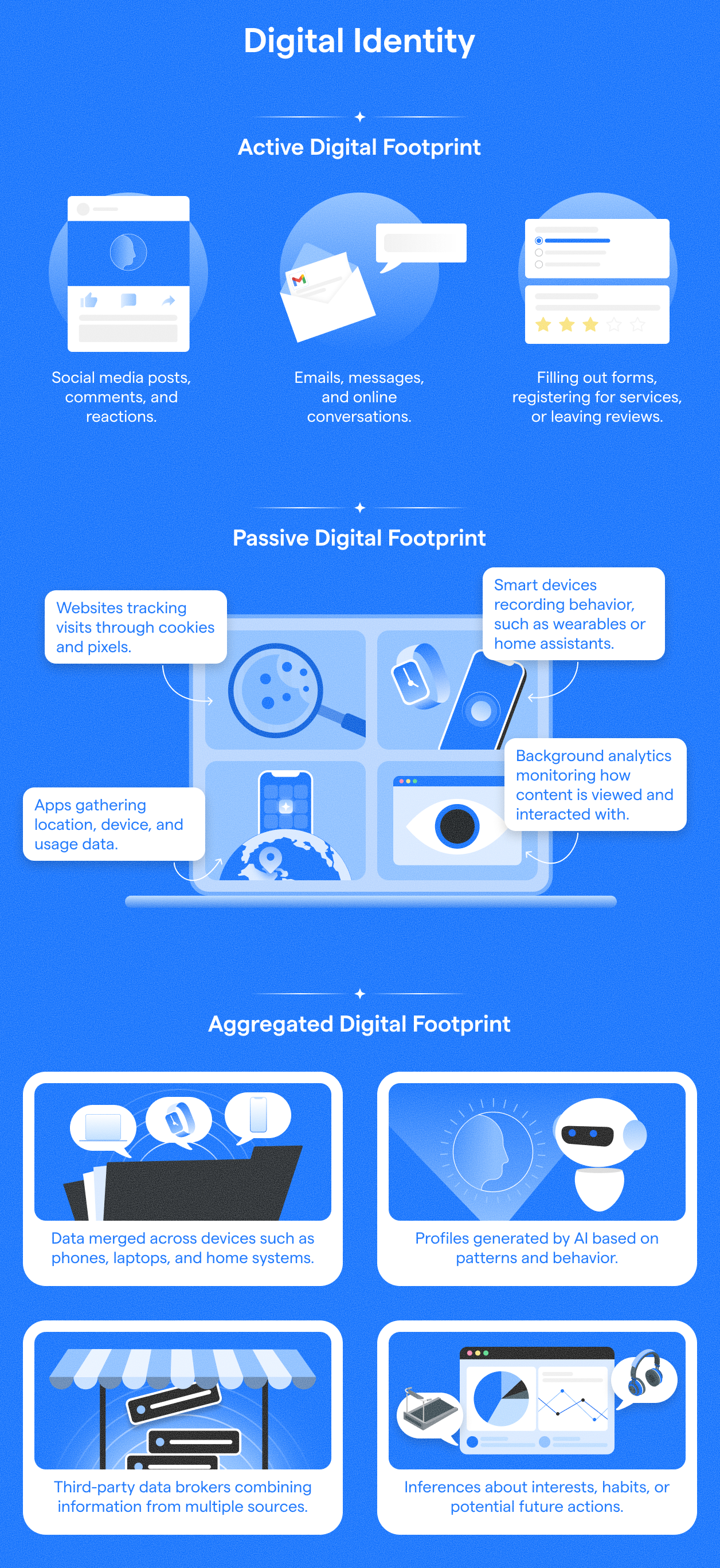
There are types of traces you consciously or passively leave behind on the internet. Your digital footprint can be divided into three categories: active, passive, and aggregated. Each of these categories defines a different way data is used, collected, and created. Let's dive in:
Active Digital Footprint
This is data you intentionally create and share online for a clear purpose and a specific audience.
Active digital footprint examples include:
- Social media posts and engagement.
- Communication.
- Willingly filling out forms, leaving reviews, or sharing feedback.
Because this data is shared deliberately, it is usually the easiest to manage and control. However, once published, it can be stored, duplicated, or redistributed beyond its original setting.
Passive Digital Footprint
Passive data is collected without direct input or awareness during everyday digital activity, often automatically in the background. It is generated by using devices, browsing websites, or interacting with apps, accumulating continuously without deliberate action.
Passive digital footprint examples:
- Websites track visits through cookies and pixels.
- Apps gather location, device, and usage data.
- Smart devices record behavior, such as wearables or home assistants.
- Background analytics monitor how content is viewed and interacted with.
Passive digital footprint is harder to notice or manage.
Aggregated Digital Footprint
When multiple data sources are combined, they can then be analyzed and ultimately provide a more comprehensive profile.
For example:
- Data that is merged across devices such as phones, laptops, and smart home systems.
- Profiles generated by AI based on patterns and behavior.
- Third-party data brokers that combine information from multiple sources.
- Inferences about interests, habits, or potential future actions.
Unlike active or passive footprints, aggregated data can reveal insights that were never directly shared. This may include predicted preferences, lifestyle patterns, or risk assessments derived from analyzing combined data sets.
)
Real World Examples
A digital footprint is more than abstract data; it has real effects in everyday life. Information collected online can influence decisions in ways that are not always visible or expected. As digital systems become further interconnected, even small data points can add to a broader profile, molding how individuals are regarded and evaluated. Common digital footprint examples include:
Employer Screening
Before making hiring decisions, many employers review a candidate’s online presence as part of their evaluation. Old posts or comments can raise concerns if they conflict with company standards, while outdated or inconsistent profiles may create doubts. Even slight signals, such as online activity or engagement behaviors, can shape how a candidate is perceived and influence the final decision.
Dating and First Impressions
In modern dating, it is common to look someone up online before or after meeting. Social media profiles often affect first impressions, while older posts or photos can send unintended signals. Differences between online presence and real-life behavior can sometimes raise doubts or affect trust.
Scammers and Social Engineering
Cybercriminals often use digital footprints to make scams more targeted and convincing. Public details such as birthdays, workplaces, or interests can be used to personalize messages or guess security information. Combined with data from breaches or aggregated profiles, this allows scammers to create highly believable messages that may reference recent activity, making them much harder to recognize as fraudulent.
These examples show how a digital footprint can shape opportunities, influence relationships, and increase exposure to security risks. Even small pieces of information can shape a broader profile, affecting perception. In 2026, it is not just what is shared online but how data points are combined and interpreted by people and automated systems.
How to Check your Digital Footprint for Free – 7 step audit
It is possible to check your digital footprint on the internet for free, though it can be a little time-consuming. We have compiled a simple seven-step guide to help you perform an initial digital footprint check yourself:
- Search your name and usernames you may have used before on the internet.
- Check your social media posts and any mentions of you.
- Look into your search history and ad preferences.
- Use tools to check if your old accounts have been breached.
- Remove unnecessary app permissions.
- Clear cookies, unnecessary extensions, and browser data.
- Run an image search and see what data is revealed.
By completing this audit, a clearer understanding of a digital footprint emerges – what is visible, what is stored, and what may require attention or removal.
Digital Footprint Checker Tools (Compared)
While basic footprint checkers focus on publicly visible information, advanced tools examine the technical side of a digital presence. They reveal hidden exposures, security risks, and how data connects across networks, domains, and systems. In 2026, understanding a digital footprint means uncovering how information is stored, shared, and potentially exploited behind the scenes.
| Tool | Best for | What it does | Free version |
| Have I Been Pwned | Security & breaches | Checks if your email or passwords were exposed in data breaches | Yes |
| AbuseIPDB | IP investigation | Identifies malicious IP addresses and reports abuse activity | Yes |
| urlscan.io | Website analysis | Scans and analyzes URLs to detect suspicious behavior | Yes |
| CentralOps Network Tools | Network lookup | Provides domain, IP, and DNS lookup tools | Yes |
| VirusTotal | Threat detection | Scans files and URLs using multiple antivirus engines | Yes |
| Hybrid Analysis | Deep malware analysis | Analyzes files in a sandbox environment for threats | Yes |
| MXToolbox | Email & DNS checks | Diagnoses mail servers, blacklists, and DNS issues | Yes |
| SSL Labs SSL Test | Website security | Evaluates SSL/TLS configuration of websites | Yes |
| OSINT Framework | OSINT research | Aggregates tools for investigating digital footprints | Yes |
| Lookyloo | Link investigation | Analyzes how websites load and track behavior | Yes |
These tools go beyond simple name searches to focus on security, infrastructure, and technical exposure. Though more advanced, they grant a deeper look at how data is collected, analyzed, and potentially exploited.
Using both basic footprint checkers and technical tools gives a more complete understanding of a digital footprint. Together, they reveal not just what is visible but also where risks exist and how online activity connects behind the scenes.
AI Digital-Footprint Scan: What’s New in 2026
Talking about digital footprint in 2026 means relying on AI-powered tools that not only track but also analyze and interpret data, resulting in increasingly precise predictions about how someone may act online.
Today, AI connects data across platforms to build a unified profile, linking scattered information and suggesting conclusions. Tools scan hundreds of sources to detect usernames, data broker listings, and breach exposure. Others compare how different systems interpret the same identity.
Another key development is cross-platform mapping, which combines data from social media, devices, and public records into a single view, exposing inconsistencies and hidden profiles.
AI search visibility is growing. AI-generated summaries based on aggregated, consistent data can shape first impressions before traditional search results.
Identity verification and an additional layer of security using AI are also trends that appear in 2026. AI now recognizes device data, patterns, and behaviors, and warns and protects using this information.
In short, digital footprint in 2026 is deeper and more detectable. The key question has shifted from what is online to what conclusions can be drawn. Those conclusions increasingly shape perception, trust, and opportunity.
See what your future employer or lead knows about you
Choosing to Opt Out of Data Brokers and Shrinking Your Digital Footprint
Data brokers are companies that collect, combine, and sell information. Actively opting out of this helps to most accurately prevent your data from being stored and later shared in one capacity or another.
To shrink your digital footprint, it is important to identify and check people-search sites, as this is where your digital footprint may be collected and appear. The good news is that most of these sites offer the possibility to request data deletion. These databases can be updated, so it is also necessary to check them again from time to time.
Here are a few simple steps to help you shrink your digital footprint:
- Locate a link to one of these sites and search your name, phone number, and email.
- If you turn up, submit opt-out requests.
- Make sure to verify those requests.
- Check in constantly to ensure that the data has not appeared again. If it does, repeat the steps.
While removing existing data is important, limiting future collection is equally important. Avoiding unnecessary registrations, reviewing app permissions, and using privacy-focused browsers significantly reduce the amount of new data collected.
Completely eliminating a digital footprint is unlikely, but consistent data broker opt-outs can greatly reduce what information is visible, shared, and sold.
Conclusion
In 2026, one's digital footprint is no longer a few pictures from childhood or old social media posts. Now, the digital footprint definition refers to a far more complex online identity profile due to the way data is tracked and later interpreted by AI tools.
It's not entirely possible to permanently delete your digital footprint, it will still show up in one way or another. However, it could be managed and reduced to a minimum. There are steps to check, and to reduce your digital footprint.
Check how AI tools see your digital footprint
FAQ
What does digital footprint mean?
A digital footprint is the data created by online activity and interactions across devices and platforms. It includes both information intentionally shared and automatically collected data, such as browsing history, location, and usage patterns. In 2026, it also reflects how AI systems combine and interpret this data into a broader profile.
Is your digital footprint permanent?
No, a digital footprint is not fully permanent, but it is difficult to erase completely. Even after deletion, data may remain in backups, third-party systems, or aggregated profiles. In 2026, AI can still draw conclusions from past activity, making some traces long-lasting.
How big is the average person’s digital footprint?
There is no fixed size for an average digital footprint, as it varies widely by activity and device use. However, everyday actions like browsing, apps, and location tracking generate large amounts of data that accumulate over time. In 2026, this data is often combined across platforms into a continuously growing profile.
Can your employer legally check your digital footprint?
Yes, employers can check your digital footprint. Usually, this includes information that can be found with a simple search. Private data should not be checked, as such an act would not be in compliance with the law.
How to check someone's digital footprint?
To check someone's digital footprint, start by searching their name. You can later check publicly available records using different tools. Now, AI tools can even build a comprehensive profile from publicly available information.
What is included in a digital footprint?
A digital footprint is a collection of actions, active or passive, taken during online activity. This may include posts, comments, engagement, location, voice recordings, and other elements. In 2026 AI tools can also build comprehensive digital identity profiles using the available data.


