

In 2026, assessing potential hires does not depend only on their CV. A potential employee's digital footprint can sometimes be even more telling, and sometimes even mandatory in certain career paths.
The previously employed methods are no longer at the basic level – casual social media checks are replaced with legally compliant, far more complex methodologies, driven by the standards pre-employment screenings must meet, as well as the need to regulate and control artificial intelligence bias to ensure fairness.
What social media screening is (and isn't)
Social media background screening entails reviewing a candidate's online presence (posts, comments, other engagement) and identifying behaviors, online actions, or content that could create a reputational or other risk to the workplace.
The main goal here is to identify any red flags that can't be easily detected during an interview or from a candidate's resume. These red flags can include, but are not limited to, harassment, illegal activities, threats of violence, and hate speech. Catching these behavioral patterns early helps the company avoid future risks and create a safe space for its employees.
It is equally important to understand what social media screening is not. Hacking into a private account or otherwise bypassing privacy settings is highly illegal, and social media screening should never be used to stalk a potential employee to see if they "fit the vibe" of the company.
Why manual social media screening is now illegal-adjacent
As more legal and ethical concerns arise regarding internet safety and the handling of private data, manual social media screening has become increasingly complex. This is not bad; on the contrary, it portrays that important issues and concerns regarding this sphere are being looked into and regulated.
However, social media screening is sometimes referred to as "illegal-adjacent". The core of why it is called so begins with a human reviewing social media profiles, and accidentally seeing a lot of information that may not be specifically spelled out, but is there. This includes seeing a picture of someone and knowing their race, gender, age, and other information that can influence even the best recruiters' decisions subconsciously. When this happens, it can be assumed that the hiring practice was discriminatory in case of a negative outcome, and this is not ethically sound.
Being exposed to information like this, as a recruiter, gives you the "Too Much Information" (TMI) bias. For example, if you see a post about pregnancy, disability that is visible, or even some strong political claims, it can and possibly will influence your hiring decision. In the event of rejection, it may become practically impossible to prove that this did not influence the final decision, and the candidate may claim discrimination.
Searching for candidates manually also poses the risk of a privacy violation, and it need not be intentional; sometimes the information is just there.
EEOC, FCRA, state laws: what you can and can't look at
When it comes to social media screening, understanding the legal framework and applying it day to day requires a thorough understanding of relevant regulations and federal law. The Equal Employment Opportunity Commission (EEOC) is one of the main enforcers of federal laws prohibiting discrimination based on religion, race, gender, age, disability, and other factors.
The EEOC is specific: any information that is considered to be protected under the law, if found during social media screening, is impossible to unsee. Therefore, using that information to make an employment decision is a violation. In 2026, automated decision-makers and AI tools will face additional regulations to ensure that bias is not present in the recommendations they generate.
What is more, the Fair Credit Reporting Act (FCRA) plays a role in legislation that is no less important. If a third-party screening tool or agency is used, the resulting information is considered a "consumer report". It is extremely important that recruiters and employers clearly state that a background check will be conducted and obtain the candidate's explicit consent before screening begins. If a company fails to do so, it can result in high legal penalties.
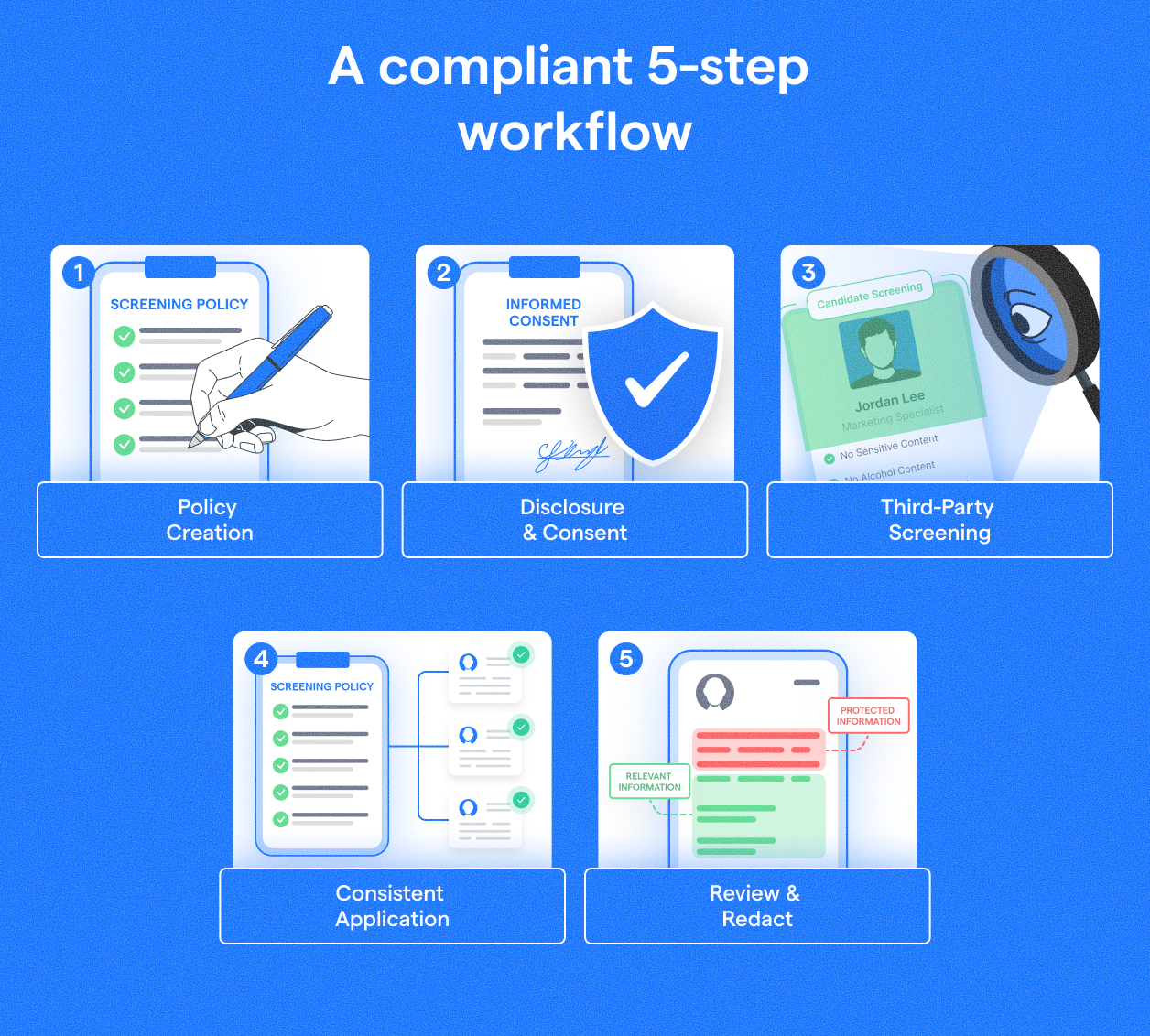
A compliant 5-step workflow
Having a standardized workflow can not only significantly improve the hiring process but also ensure compliance with applicable laws and help manage, or even prevent, potential risks. Here's an example of what a good workflow may look like:
Step 1: Create policies before searches begin
Companies and organizations have to establish a clear social media screening policy. It should include and define the elements recruiters will be looking for (e.g., illegal acts), and what should be ignored following the law (e.g., religious beliefs). That way, you ensure a written document is in place for consistency. Consult with the legal team to ensure compliance with all applicable laws in the candidate's area.
Step 2: Disclosure & consent
Before performing any background or social media check, the employer must provide the candidate with a standalone document disclosing that a social media check will be conducted. This has to be done in accordance with the FCRA. It must be separate from the employment application, and explicit written consent must be obtained from the candidate before commencing screening.
Step 3: 3rd party screening
To avoid bias or the previously discussed 'too much information' (TMI) problem, employers can use a third-party service, an AI product, or a social media check tool. This protects the recruiter from seeing information that may illegally influence their decision-making, and only relevant triggers are shown.
Step 4: Consistent application
The screening process must be applied consistently to all candidates at the same stage of the hiring process. For example, if the policy dictates that screening occurs after a conditional offer of employment is made, this rule must be followed for every applicant.
Inconsistencies in applications can lead to allegations of targeted discrimination.
Step 5: Review & redact
When a report is sent back, the information included should be relevant only to the predefined policy criteria. All profile photos, personal details, and unrelated content must be redacted. Recruiters should review the flagged behaviors objectively, ensuring that any decisions made are based solely on legitimate business concerns and not on protected characteristics.
AI social media screening: how it removes bias
Introducing and integrating AI into the recruiting and hiring processes had a very positive impact on the industry. When performing an ai social media background check, it ensures (or must ensure) that all actions taken are compliant with the law and do not discriminate against candidates based on the factors we outlined in this blog post. That is the greatest benefit of using AI in this sphere. In short, AI changes how data is gathered and analyzed, addressing and improving on the issues manual search had.
Furthermore, AI algorithms can be trained to ignore visual and textual cues related to race, gender, age, religion, and other protected characteristics, and instead, when the scan is performed, it is instructed to follow specific keywords, phrases, or even behavioral patterns that correlate with the risk criteria that the employer has outlined.
As with most processes, AI offers speed and scale that is a huge challenge to match manually. While a recruiter may spend a long time researching a candidate, a process that can sometimes take hours, AI can do so in a matter of seconds, and with expected quality as well as adhering to regulations.
Screen compliantly with WhiteBridge (demo)
Tools & companies compared
In 2026, the recruiting market, particularly in social media screening tools sphere, saw a significant jump thanks to AI. Choosing the right tool or partner for this process is extremely important, not only to prevent bias in hiring but also, if not more, to ensure compliance with legal regulations.
We have outlined a few social media screening companies that lead the industry:
| Company | Key Features | Best For | Compliance Focus |
|---|---|---|---|
| Ferretly | AI-powered analysis that flags behaviors, not beliefs. Offers explainable AI and supports over 230 languages across 50+ platforms. | Organizations seeking fast, highly objective, and transparent AI screening. | Strict FCRA compliance with a strong emphasis on removing protected class data. |
| Fama | Enterprise-level solution utilizing advanced Natural Language Processing (NLP) to identify complex risk patterns and toxic behaviors. | Large corporations requiring deep, nuanced analysis of online behavior. | Robust compliance frameworks designed for enterprise-scale risk management. |
| Checkr | Integrates social media screening seamlessly with traditional background checks (criminal, credit, etc.) into a single platform. | Companies looking for an all-in-one background screening solution. | Comprehensive FCRA compliance across all screening modalities. |
| Cisive | High-end, comprehensive screening services that combine AI technology with expert human review for complex cases. | Highly regulated industries (e.g., finance, healthcare) requiring meticulous vetting. | Adherence to complex, industry-specific regulatory requirements. |
| Social Discovery | Specializes in deep-dive investigative reports, uncovering hidden digital footprints and complex online associations. | Executive-level hiring or roles requiring the highest level of security clearance. | Focuses on legal defensibility in high-stakes hiring scenarios. |
What to do with red flags (adverse action)
If a red flag is identified during screening, specific actions must be taken to ensure compliance with all required regulations. The findings may influence the decision, and, in the case of a rejection to hire (in other words, "adverse action"), FCRA has outlined how to handle that specifically.
-
Issue a pre-adverse action notice
A copy of the report that contains the red flag, as well as a document titled "A Summary of Your Rights Under the Fair Credit Reporting Act," has to be given to the candidate before the final decision. This is an essential step: the candidate is informed about the issue at hand and given the opportunity to review.
-
Allowing a waiting period FCRA does not specify a waiting period after the pre-adverse action notice, but it is a general practice to give 5 business days for the candidate to review the report and provide additional context or explanations of the red flags. Sometimes the red flag may be taken out of context, creating friction, but within a reasonable explanation, it can be something different from what was first considered. Sometimes even the account that, for example, posted a flagged post might belong to someone with a similar name.
-
In case of proceeding with rejection: final adverse action notice If the waiting period, the review, and everything in between have passed and were conducted correctly in the legal context, and the employer still decides to decline the employee's application, then the Final Adverse Action Notice must be issued. This document must include a statement that the candidate will not be hired due to the information flagged in the screening report. The rejection could be based entirely on it or partly on it; that also has to be stated.
Other important elements to include:
- Contact information of the screening company that issued the report.
- Reiteration of candidates' rights to express disagreement with the findings.
FAQ
Can I look at a candidate's private Instagram?
No, you cannot view a candidate's private Instagram account or any other private account. Accessing a private account through bypassing is highly illegal, and social media screening should be conducted only using publicly available information.
What if I see something discriminatory about a candidate?
If you see something discriminatory about a candidate, it can lead to a "Too Much Information" (TMI) bias, making it practically impossible to prove that hiring was non-discriminatory. Using protected information to make an employment decision violates federal laws enforced by the EEOC.
Do I need candidate consent for social media screening?
Yes, you need explicit written consent from the candidate for social media screening. Recruiters and employers must clearly state that a background check will be conducted and obtain the candidate's explicit consent before screening begins.
Is a social media background check legal?
Yes, social media background checks are legal when conducted in compliance with federal and state laws. It is crucial to comply with regulations such as the FCRA and EEOC guidelines to avoid legal penalties and discrimination claims.


