

Increasing concerns of data privacy and fraud are shaping the pre-employment screening in 2026. Now, this process has become more complex and is highly technology-driven, with remote hiring on the rise, which is driving the need for stricter regulations. Now, instead of a simple background check, there is an enhanced process that includes identity verification, skills validation, compliance screening, and more, all contributing to pre-employment screening. AI also plays a key role in this, allowing teams to screen quickly but raising concerns about fairness and legal implications.
What pre-employment screening covers in 2026
Screening has become a form of risk management and trust verification in the hiring world in 2026. With global and remote hiring practices becoming more and more common, screenings also take place more often, and they not only include a criminal record, but are also way more diverse than before.
Digital identification has become a key part of screening in 2026, encompassing biometric verification, fraud detection, and document authentication. Companies increasingly use various tools to implement these methods because of the potential threats posed by fake IDs, credential fabrication, and even deepfakes. Now it is easier to hire remotely, and cross-border recruitment is becoming more common, which is consequently a major driving force behind digital verification.
What also changed is the need to check possible candidates' skills and verify that they were truthful in their CVs. Degrees and job titles are not the main selling point anymore. That is why potential employees are now asked for portfolios, no longer the main selling points, or to complete a technical task, proving their practical skills required for the position. Considering this, screening becomes not only an identification process but also a process of trust.
Continuous monitoring is also becoming more common. There are cases in which employers continue to monitor their employees throughout employment, rather than relying on a one-time background check. This usually happens in job positions that require the employee to handle sensitive data, work with public safety, or handle financial transactions.
However, laws are also being enforced to ensure that private data remains safe, even in the employment process. In the EU and many US states, candidates have stronger rights to challenge inaccurate information and to understand how automated decisions affect hiring outcomes.
Why recruiters are moving screening to AI
Recruiters are moving pre-employment screening to AI because modern hiring has become too fast and too large-scale for fully manual processes. Remote hiring also opens the door to hundreds of applications for a single position, and here AI helps screen potential employees more efficiently.
First and foremost, AI employment in the screening process is highly time-efficient; what a person can do in a day, AI-powered tools can do in minutes, and sometimes even less. This includes document verification, inconsistency flagging, and qualification checking. This way, the hiring process is not only sped up, but also the administrative, repetitive work for the recruitment team is greatly reduced.
Another advantage, sometimes overlooked, is fraud prevention. With remote hiring becoming increasingly popular, many people fake their CVs, sometimes provide false credentials, and even forge their identities. Here, AI systems are designed to detect such inconsistencies and, with sufficient knowledge, authenticate documents independently to speed up a traditional manual check. In other words, AI can replace the manual verification process to prevent fraud.
Recruiters also use AI to support skills-first hiring. Now, recruiting teams can use AI to verify the validity of acquired certifications and other assessments, assess skills, and even list candidates who, according to the requirements, are strong enough for the position, reducing accidental oversight.
An AI background check for hiring can reduce manual verification time and improve fraud detection, but most companies still keep humans involved because of fairness and transparency regulations.
The 5 screening categories AI handles well (and 1 it doesn't)
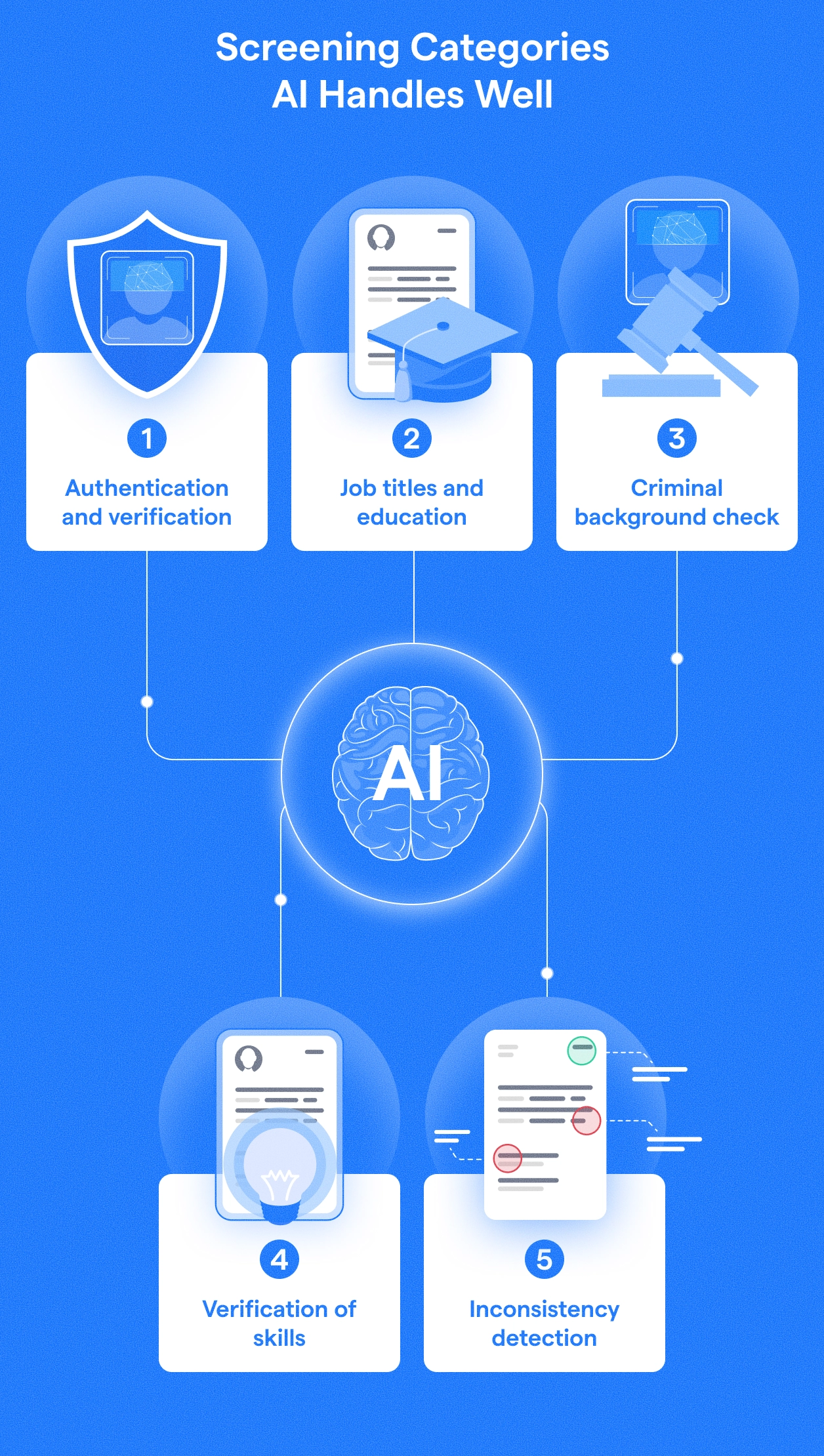
Just as in any other sphere that employs AI, the recruitment department can also benefit greatly from AI implementation. AI can effectively handle tasks such as pattern recognition, data analysis (often in large volumes), and manual tasks that can save time. However, the AI shouldn't be left alone – human judgment remains a fundamental part of its progress.
1. Authentication and verification
With correct data, AI can quickly verify and authenticate official documents.
2. Job titles and education
AI can help validate the education and previous roles listed in the resumes candidates send.
3. Criminal background check
Checking criminal backgrounds often requires a large dataset, which AI can efficiently handle. However, as with any sensitive or key data used to determine a hiring outcome, human judgment is also important in reviewing flagged information.
4. Verification of skills
When job requirements are given to the AI, it can compare them well with the resumes, assessments, portfolios, and certifications of the potential employees. Aside from the time saved, AI performs well in skill-first hiring.
5. Inconsistency detection (fraud)
As hiring moves to a global scale and often involves remote work, AI has been trained to be particularly strong at detecting and flagging fraudulent applications.
Human judgment cannot be handled by AI
For the final say on whether the candidate is fit for the job, it is usually the human recruiter who decides. Soft skill evaluation is not a strong suit for AI, because it usually requires more context to make good decisions.
Book a Whitebridge recruiter demo
FCRA, EEOC, GDPR: what's legal and where
FCRA (Fair Credit Reporting Act), EEOC (Equal Employment Opportunity Commission), and GDPR (General Data Protection Regulation) are three frameworks that most significantly influence hiring practices globally.
In the US, the Fair Credit Reporting Act (FCRA) regulates how employers conduct background checks through using third-party tools. Employers must obtain written candidate consent before screening and provide disclosure about the decisions. Candidates also have the right to review and dispute inaccurate information.
The Equal Employment Opportunity Commission (EEOC) focuses on preventing discrimination in hiring, meaning employers cannot use screening practices that unfairly target protected groups based on race, gender, age, disability, religion, or other protected characteristics. Even legally obtained background information must be fairly applied.
In the European Union, the General Data Protection Regulation (GDPR) imposes stricter limits on the collection, storage, and processing of candidate data. Employers must show a legitimate reason for screening, minimize unnecessary data collection, and clearly explain how candidate information will be used. Automated decision-making and AI-based hiring tools face particularly close scrutiny under EU privacy rules.
Outside the US and EU, many countries are introducing similar regulations and as international hiring expands, employers increasingly need screening processes that comply with multiple legal frameworks at the same time.
How to Use AI in Screening
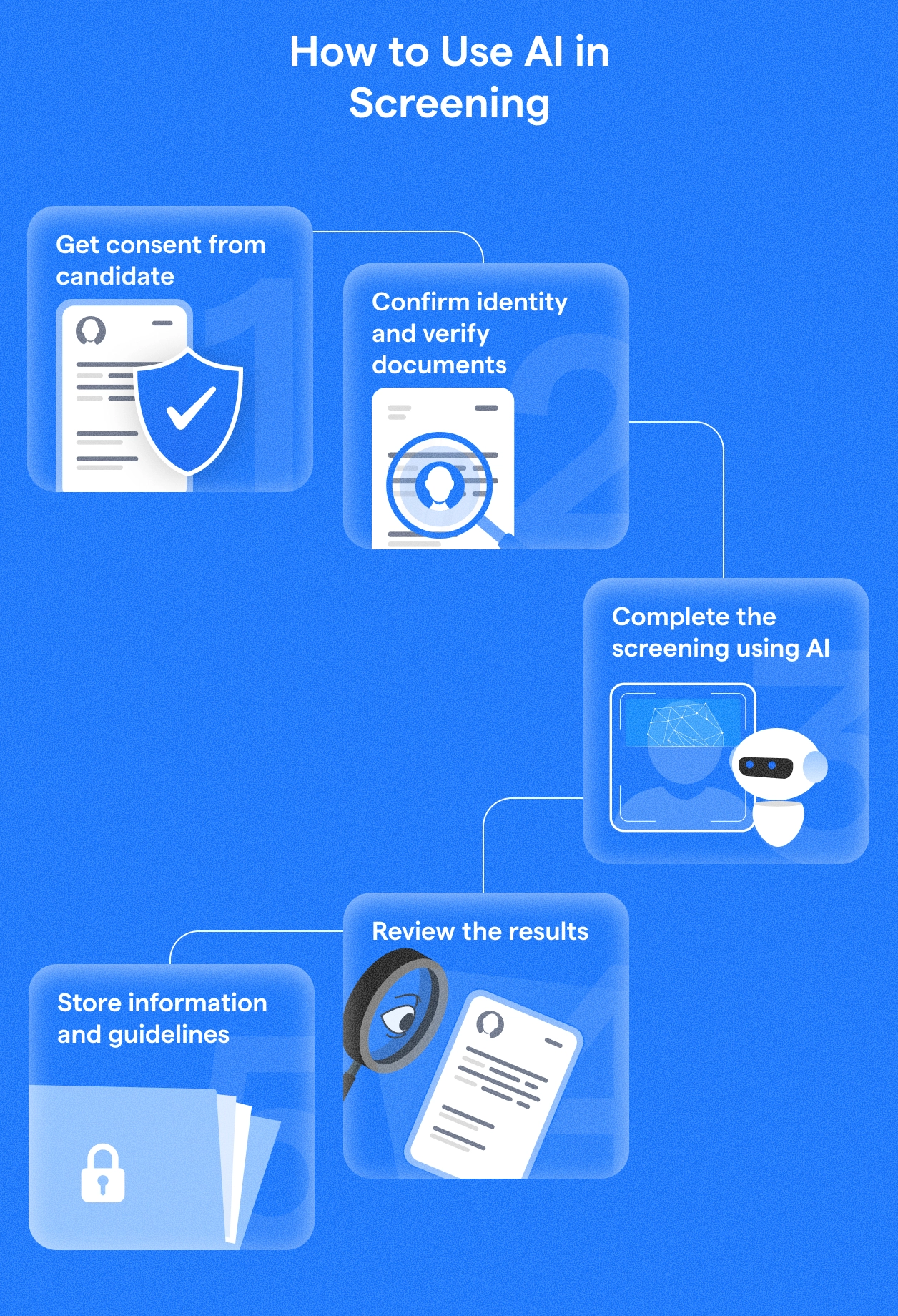
Let's look into the process of using AI for background checks and screening:
1. Get consent from the candidate
Each employer must inform candidates about the AI tool's use, what information will be collected, and how it will be used or processed.
2. Confirm identity and verify documents
Before any information is analyzed by AI, the recruiter should confirm that it is truly the person they are considering as a potential candidate and that all of the documents attached are valid. Automated analysis will work best if all of the inconsistent information is addressed beforehand.
3. Complete the screening using AI
Now AI can check whether the candidates' skills match the job description, whether there was any fraud on their part, and whether any information is needed for the recruiter and is within legal bounds. This, however, shouldn't be the final stage of recruitment; AI should not make a hiring decision on its own.
4. Review the results
Involving human judgment in the hiring process is an essential step, because automated recruiting still misses the soft skills a person may have and does not have the context we, as humans, can get during an interview. Besides, there can be legal risks with leaving everything to the AI.
5. Store information and guidelines
The screening records should be stored in a secure place, and the way decisions were made should also be documented somewhere, giving the candidates the right to correct any information that was falsely outlined by the AI.
All About AI Background Check
A traditional employment background check can take several days when handled manually. Traditional vendors would first contact employers, then confirm all required documentation and identities, and review previously generated reports or criminal databases. This process is not wrong or bad; it heavily depends on human processing, but it is time-inefficient.
On the other hand, when an AI conducts a background check, it enables rapid, efficient application of methods such as pattern recognition and automation. Therefore, any information in the CV that does not match publicly available information elsewhere on the web, if the identity is false or the documents have been tampered with, can be detected and flagged very quickly.
The scale in which both traditional vendors and AI operate is simply very different. Global, high-volume campaigns can be a huge struggle for traditional vendors, but AI here can do wonders in processing that information quickly, even across different languages.
Another advantage AI tools offer is their ability to conduct continuous screening even while a person is employed, in industries that require working with sensitive data, finances, and public security.
Social Media Screening (Is it Legal?)
While social media screening may seem like an easy, no-brainer task, recruiters must be careful not to violate any privacy laws while doing so. On top of that, there is a risk of discrimination, so it is better to use social media screening in a limited manner rather than solely relying on what you can find there about your potential employee.
When conducting a social media screening, it is important to limit it to checking only concerns relevant to the position the person is applying for. For example, it could include harassment, violent threats, or activity that can be deemed illegal, but personal beliefs, religion, and other private information are protected by law and cannot be the determining factor in employment.
To help prevent recruiters from seeing that information, many companies now rely on social media screening for other professionals, and the recruiting team moves forward with the process only after the previous team gives the green light. A social media screening tool can help recruiters identify publicly visible risks while maintaining compliance standards. If there is no additional team and the task relies on AI, it must also be disclosed that AI performed the screening, so any candidate can argue their case if any of the information was untrue.
To put it simply: any recruiting decision has to be made through human judgment as well. AI can help, but when information is highly sensitive or might influence decision-making, it's important to have a human review it as well. As long as the process is handled correctly, social media screening is legal.
What is More Costly: AI or a Traditional Vendor?
AI background checkers or screening platforms are cheaper because most of their work is automated, leaving the client to make the final judgment, and there is no need for manual labor because all data is reviewed and analyzed in real time. Here, traditional vendors can monetize each candidate screening or additional features, and the price you pay can increase quickly if you need a well-rounded report.
It is important to mention that a full AI screening platform will not always be very cheap. Just like with most things, the reports still require human attention and judgment, and as the data privacy dialogue continues and AI becomes increasingly smart, the costs can rise as well.
To ensure speed, legal protection, and quality, most companies choose a mixed approach between human and AI screening.
Perform a background check in 2 minutes
FAQ
Is AI screening compliant with the FCRA?
Yes, AI screening can be compliant with the FCRA principles. Employers need to follow the rules on consent and disclosure, inform candidates of screening, and allow the results to be challenged if the information is found to be inaccurate.
Is written consent required for social media screening?
Yes, you need written consent or social media screening in many cases, especially ones where AI or other automated tools are involved.
Can AI screening introduce hiring bias?
Yes, using AI for screening can show hiring bias. That is why it is important to add a layer of human judgment to the equation.
How much does AI background check cost?
AI background checks typically cost between and 0 per candidate, depending on the depth of screening and the provider.
Is a social media background check legal?
Yes, social media screening is legal in many countries, as social media content is generally considered public information. However, it is important not to let private information lead to a decision in hiring, or request access to accounts that are private.


