

In 2026, your online reputation management is no longer a side effect. It is a core part of how you’re perceived in real life. Whether someone is hiring you, working with you, or meeting you for the first time, chances are they’ve already formed an impression based on what they found online.
The issue lies with the validity of the information shared online. Often it is incomplete and inaccurate. The search results, algorithms, and content you or others have made in the past shape that reputation to one extent or another. Avoiding online reputation management risks drastically alters your presence from what it is today.
How does online reputation management work for individuals? What can a person realistically do about it? How to run a quick self-audit and fix any issues over time? All of that is covered in our guide to personal reputation management.
Let's dive in!
Why personal online reputation matters more in 2026
In 2026, the line between “online” and “real life” has effectively disappeared. The fact that many people (potential employers, dating partners, sales reps) conduct online reputation checks is no secret. The way you appear through the search results can affect different areas of your life.
First impressions are formed quickly by potential clients, employers, and even people who are considering dating you. What they find is influenced and shaped by the algorithm, there is always a risk that the context that matters is missed, which can lead to an unfavorable decision.
It is also important to note that more and more of past online activity is being indexed or archived, shared across different platforms. For example, a comment that was made years ago can resurface, appearing in diverse scenarios or reaching unintended audiences.
That is why learning to manage your online reputation is very important. It's a form of personal infrastructure, that can lead to opportunities, builds credibility, and likewise it can also limit them if left unattended. Therefore, reputational management becomes a necessary element of visibility, accuracy and control.
What online reputation actually is (and isn’t)
Your online reputation consists of content you have published, posts, pictures, what can be found out about you from searching your name, where you have been tagged, and, in general, anything that has been published about you or your work.
What is more, this reputation is shaped not only by what exists and is found in an online search, but also by which pieces appear first or at the top. That is not controlled by you, it is simply shaped by the algorithm, and as time goes on, top search results can also vary.
It is important to remember that what you see online about yourself is not a complete or accurate representation. There is far more context that is not explored, and that can also become visible once someone gets to actually know you. However, first impressions for recruiters, clients, or anyone else who decides to look you up are made, and you can ensure that the search results depict the image of you that you wish others to see.
Steps to Take for Online Reputation Management
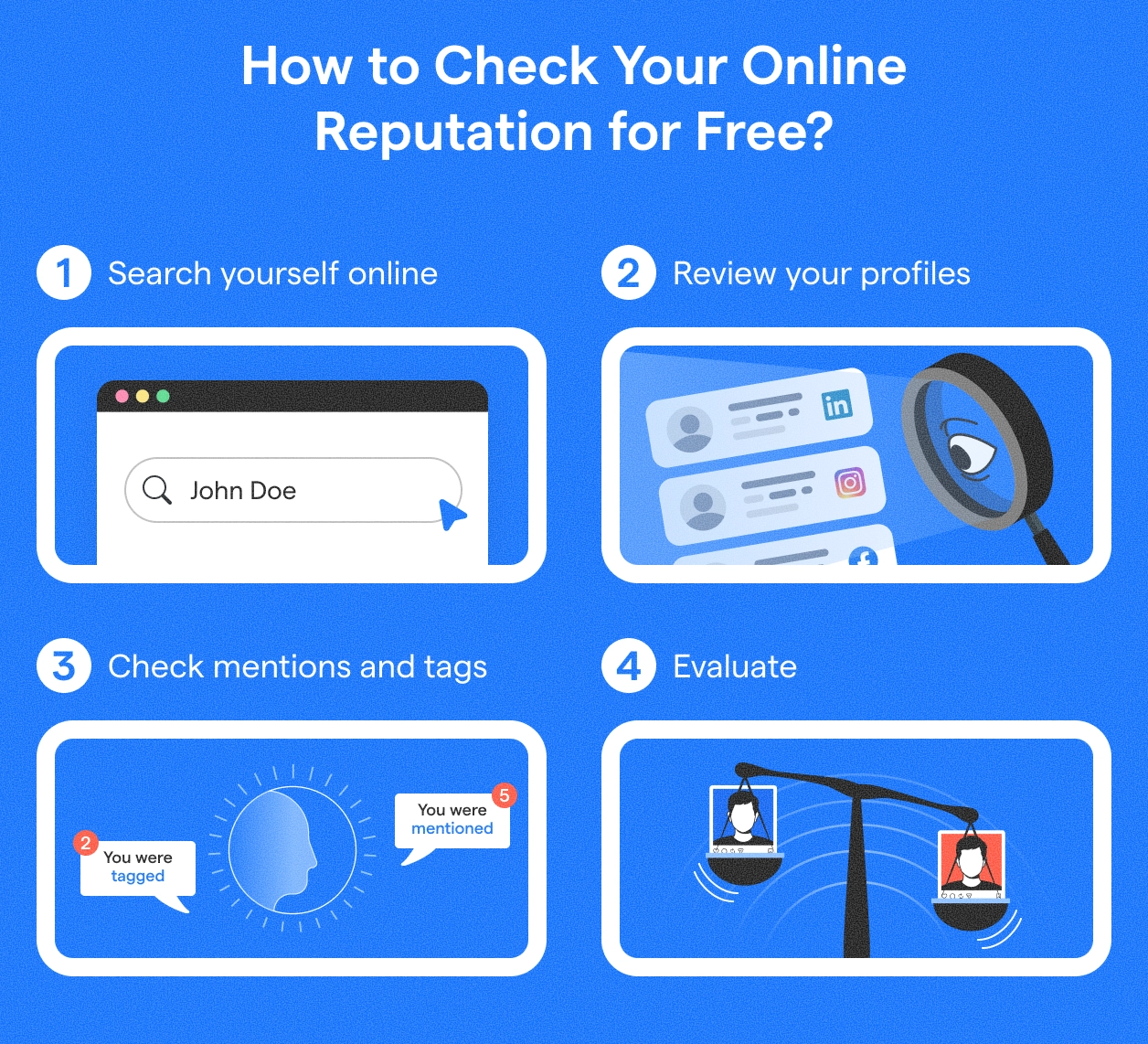
If you ever wondered, "What is my online reputation?", you are certainly not the first. At first, you can check your online reputation yourself. Expensive tools can seem like a very drastic first step, which is why we encourage beginning with a simple, four-step action plan.
1. Search yourself up
After you choose a browser, open it in incognito mode, then type your name. Do not forget to try a few different variations or combinations, including your name and your city, maybe your job, or some previously used usernames. Browse through images, look at a few pages, and click through less common information.
2. Check your existing profiles
Step into the shoes of a potential recruiter or a client and think about what information they would look for. Do evaluate your bios, what impression pictures you post can give, and re-read your recent posts. Then, decide if you would be comfortable if a potential employer or client found that about you.
3. Information from other people
What others post about you is equally as important. Revisiting content you were tagged in or mentioned in any form also has an impact on your online reputation. Make sure to decide whether the way you are portrayed in others' online activity helps create a positive impression of yourself.
4. Take time to evaluate
After you have done all these steps, take time to evaluate how you are seen by others and what impression you make on people from different backgrounds. These four steps are not a complete guide but a good step in the right direction in beginning to understand how others view you online and the first step in managing your online reputation.
Check your online reputation right here and now
Tools to Use to Check Your Online Reputation
While it is true that there are many tools to help evaluate an online reputation, many of them are company-focused and provide minimal benefit to individuals seeking to begin their reputation management. However, here are some online reputation checkers that can help evaluate what is the best fit for you:
| Tool type | What it does | Best for | Limitations |
| Free monitoring tools | Track mentions of your name across the web | Basic visibility | Limited coverage, often delayed, little context |
| Social listening tools | Monitor conversations across social media, forums, blogs, often with sentiment analysis | Understanding how you’re perceived online | Can be noisy, complex, and overkill for individuals |
| Review management platforms | Collect, track, and respond to reviews in one place | Freelancers, founders, public-facing professionals | Not useful if you don’t rely on reviews |
| All-in-one reputation platforms | Combine monitoring, analytics, and response tools | Businesses or individuals with high public exposure | Expensive, complex, not designed for everyday users |
It's important to note that most people do not need an extensive search. If you want to manage your online reputation, you need to stay alert and aware of important information that may show up, and then take action to change it or respond and using an online reputation report can help with that.
Managing Your Online Reputational Risk
Nobody is protected from reputational risks that may appear. Often negative and misleading, this information damages your reputation, and immediate action is required. Usually, there are three options to tackle this problem, and they are not mutually exclusive.
Deletion
The first step is to determine whether the content damaging your individual online reputation can be taken down. This usually includes removing the content if it is posted from your personal accounts, untagging yourself, asking the content's owner to take it down, or using the platform's functionality to take it down. There are some instances where you can request that content be removed from search engines.
Cases such as outdated information, privacy breaches, or content you can control directly can be managed using this method.
Overrule
There will be cases where deletion or removal simply won't be an option. Knowing this, the better approach is to outrank it by creating your own content. Simply put, post online about who you are now, strengthen your positive personal brand, and update everything that can be updated. This way, you build credibility and counteract content that has a negative effect on your online reputation.
Creating more relevant, up-to-date content will push down the content that negatively impacts your online reputation, because content is now more competitive.
Engage
Engaging becomes necessary when you are being inaccurately represented or mistreated online. There are extensive guides that help you use this method correctly, sometimes even with the help of professionals who know what to say and how to say it in a response. What is important here is that you approach it politely, take accountability, and never do so angrily or with intense negative emotions. Sometimes, the way you respond will become more important than the present issue.
How to Continue to Monitor Your Online Reputation?
The previously outlined steps can help with temporary fixes to improve your online reputation, but continuous monitoring is also required. Now more than ever, information continues to flow every day, and each comment, mention, or post can have an effect (positive or negative) on your online reputation. Sometimes, even small changes can shift how you are viewed by someone who decides to look you up.
However, there is no need for individuals to purchase expensive subscriptions to monitoring tools. Constant monitoring can be achieved through a mix of habits and available free tools.
Google has a feature called "Google Alerts" that notifies you when a desired keyword is mentioned online. The keyword in your case could be your name. It's free and fairly easy to set up as a starting point to keep an eye out for any real-time changes to your online reputation. There are some tools that provide a more in-depth look at social media and other online platforms. These tools include Brand24 or Mention.
Tools, however, do not take into account the context of the content and messages being published. It's also a good practice to do a short weekly check-in by searching your name, looking through images, or tags. That way, you will have a clearer and more well-rounded view.
Contrary to usual belief, you do not have to fix everything that is being said about you online. Having specific areas to focus on is more beneficial and time-saving. For example, check the first page of search results, scroll through forums relevant to your field, and update your social profiles.
Continuous online reputation monitoring will work if you respond to what you find, in one way or another, but remember that tracking everything in real time as an individual is not possible. Focus on creating a lightweight system with simple alerts and perform deeper checks once in a while.
When an Online Reputation Management Company is Worth It
It is true that most online reputation management can be done yourself; however, in some situations, it can be too difficult to handle, or the reputational risk has gotten out of control. When reputational risk is high and there is fear that a single wrong comment could cause permanent damage, it is time to seek professional help. Here are some examples when you should consider letting someone else take care of your online reputation:
1. Consistent negative information flow
Sometimes, overruling misleading content in search results can prove difficult due to a lack of knowledge or an inability to properly rank content higher. In those cases, SEO experts can help push forward content that is useful and accurately represents you online.
2. Lost opportunities
Noticing that your online reputation is negatively impacting your personal and professional life, such as hiring opportunities, keeping clients, or even receiving job offers, it might be time to consider investing in professional help. It can range from advanced tools to even legal help, if it fits your situation.
3. Loss of privacy and illegal activity
In cases that involve illegal activity, for instance, doxxing, impersonation, and leaking sensitive personal information, more drastic measures should be taken. These instances require not only legal expertise but also high-level technical guidance, and experienced firms usually have a combination of both.
4. When you don’t have the time or expertise
It is also true that online reputation management takes not only time but also consistency, and that is a resource not everyone can afford. A hired company, in that case, would already have a systematic and methodical approach in place.
5. When your public visibility is growing
As your visibility grows and your career lifts off, proactively managing your reputation can greatly benefit you and help mitigate future risks.
It is still important to note that an online reputation management company may still face some difficulties, and it is almost impossible to erase everything. If you feel that online reputation management is more of a hygiene for you, then it is just as good to rely on your own actions.
Where Online Reputation Matters
Your online reputation does not exist in a vacuum – the context around your name is very important to anyone who needs to make a decision about you. For individuals, there are three major areas where an online reputation can influence others' perception of you. These include building your profession, job hunting, and dating life.
With the help of the internet and tools, as well as actions to build your personal brand, freelancing or creating a business heavily relies on online reputation. It not only becomes a major part of your credibility but also should provide a consistent and strong evidence of your past work, as well as the way you see or think. To ensure you are not declined an offer before the conversation even begins, build a consistent online reputation surrounding your brand and your work through content and social profile optimization. Having that in place, you are already more likely to close a deal.
Not all of us are founders or freelancers, and the vast majority enter the job seeker market constantly. With the oversaturation in specific areas, finding good candidates becomes difficult. With good online reputation management, standing out from the crowd is more possible than you may think. Help recruiters shape a positive opinion about you – fix your online profiles to portray relevant skills and experiences, make sure there are no off-putting search results (refer to the previously discussed steps), and take into account the small details, like the tone you write your content in, and how professional you appear.
Online reputation increasingly influences personal life. It is not uncommon for potential partners to look you up online. However, these people are not exactly looking for an extremely professional person – they are evaluating your values, the areas you care about, and the so-called red flags, and whether they can find any. People change and mature over time, so outdated content can create a false impression of you.
There is no need to prepare your online reputation for every possible scenario, but maintaining and managing it is important. People form impressions quickly, and nowadays they don't even need to meet you to do so.
FAQ
Can I remove negative Google results?
Yes, you can remove negative Google results, as long as they include breaches o your privacy, violate policies or are created by you. If none of these boxes are checked, then you should either push down content or engage with it respectfully.
How long does online reputation repair take?
Online reputation repair can take weeks or months. There are some actions you can take immediately, like content deletion or updating your profile. However, there are cases where rebuilding credibility takes longer.
What is online reputation?
Your online reputation is the impression you make when someone searches for you online. It is important because people from various areas of your life form impressions of you based on the content they see.
How to check your online reputation for free?
You can check your online reputation for free by searching for your name in incognito mode in your browser. Check the first page of results and evaluate if that is how you want to be seen.
What should be in a free online reputation report?
You should expect search results, online profile overview, and tagged or mentioned content from your free online reputation report. Risks and gaps should also be outlined, along with outdated information. How to improve online reputation?To improve online reputation, focus on four simple steps that include searching yourself up, updating profiles made in the past, looking through what other people shared about you, and evaluating the information you find.


