

Sales Intelligence in 2026 has become quicker and far more focused with the rise of AI. AI enables the sales team to make quick decisions based on real-time data and signals, combining traditional company data enrichment and contact finding with a new, revised approach to focus areas.
The biggest change is the dynamic decision-making that allows for modernizing the process of connecting signals across different accounts, people, and markets to surface intent, placing emphasis on focused actions in a successful revenue process.
In this blog post, we will explore the AI Sales intelligence landscape in 2026.
The Dynamics of Sales Intelligence in 2026
In 2026, sales intelligence has undergone a significant evolution. At its core, sales intelligence is the process of collecting and interpreting buyer and account data to improve sales decisions. AI-driven decisions are being made in real time, interpreting signals from buyer behavior, account activity, market activity, and more. This is extremely helpful for revenue teams because it now shows the areas and accounts to focus on, and the moment of engagement.
The additional AI layer to sales intelligence tools helped to create a shift from reactive research to proactive actions and opportunity seizing. Manual context building is no longer the best approach, because now AI sales intelligence systems actively show buying intent, and not only that – they also give an explanation why they matter, and how to engage properly.
What is more, static snapshots are becoming a thing of the past. Sales intelligence tools now constantly update account intelligence and generate a summary of what is important to the revenue team: the challenges people within the company face, the stakeholders involved, and, in general, what is happening within the company. It is good news for any sales team – much of the manual research is no longer needed, and outbound no longer slows down.
Network and relationship sales intelligence is also a very important update. With the help of AI, it is now possible not only to know who the contact is but also how decisions are being made inside a company, thanks to the sales intelligence system.
Possibly the most important change is how sales intelligence AI interacts with the sales teams. Instead of only portraying what is happening, the system creates a clear outline of what to do next, with steps that can include message tailoring or detecting a pain point that might have been missed.
Sales Intelligence Stack
Modern sales intelligence stacks rely on building, interpreting, and enriching information layer upon layer until the end result becomes a clear plan, with a strong informational base, interpreted results, and specific actions the sales team should take.
Base layer of data
The first layer, and the foundation layer, is the one that includes all relevant information, such as CRM records, product usage data, firmographics, and more. Previously, this was the essence and at the same time the entire functionality of sales intelligence, but now, with the progress made, it is only the base layer that provides completeness.
Layer of signal and intent
The second layer includes AI systems that probe the raw data and provide relevant context, making suggestions of potential buying activity more thorough. This context consists of various websites and how their content is engaged with, from hiring and funding announcements to social and market activity, and everything that lies between those actions.
As part of the sales intelligence stack, this layer is extremely helpful for sales teams because the signals it portrays may be missed due to human error or other factors.
Account and relationship intelligence layer
The third layer is very beneficial, mainly because of its interaction with the previous layers. Here, data and the signals derived from it are combined and interpreted as context, which is not isolated to a single account.
Here comes identification with key stakeholders and how they influence the buying process, as well as consideration of the whole organization. Naturally, pain points and priorities are also considered, and those conclusions are later summarized through account narratives. Instead of an overall view, sales reps can see decisions made from real-world information processing.
The action layer
The last layer, or the top layer, is where all previously processed data and suggestions from the context of individual accounts, as well as complementary context about the company and stakeholders, are summarized and presented as actions to take.
Those insights usually include:
- The priority of which accounts to consider first
- Suggestions of what to include in the messages
- A list of actions for each sale
- Portraying red flags in sales pipelines
- Outreach workflows
You can think of this layer as the pivotal one, turning the whole stack into a sales engine rather than a sales intelligence tool.
Sales Intelligence Tools and Their Comparison
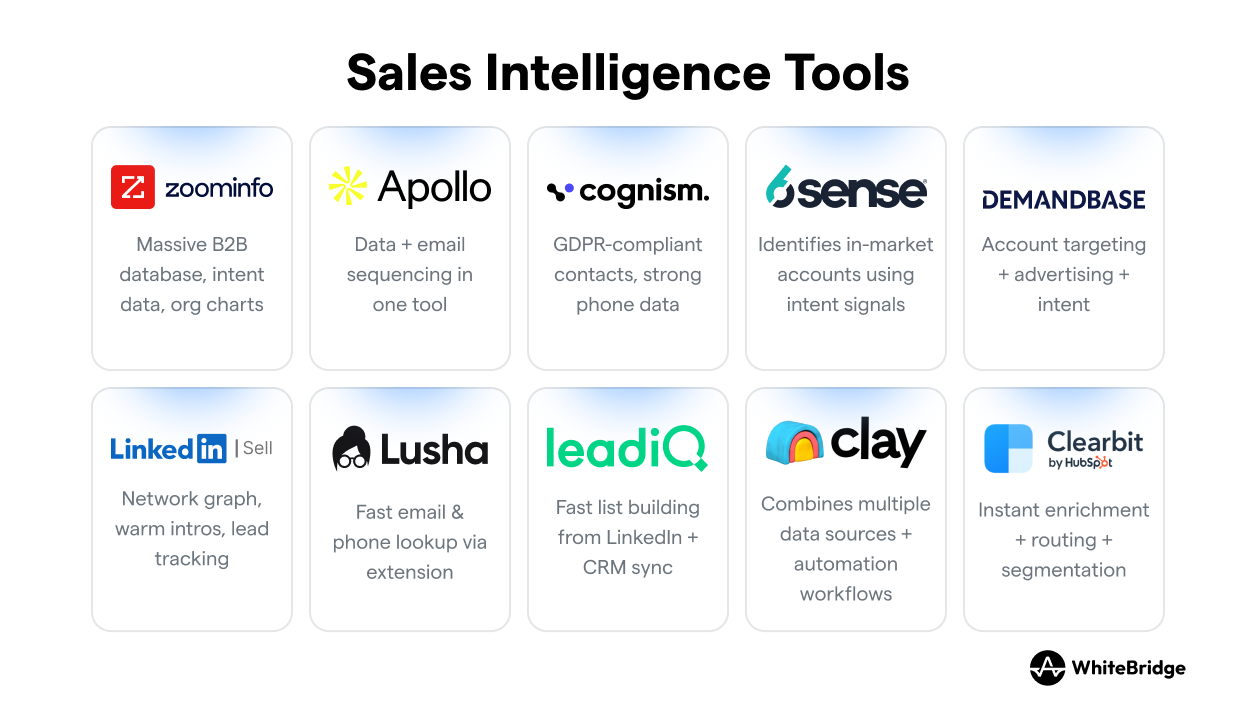
Sales intelligence software or tools should be implemented in every company's workflow to achieve the best results. There are numerous them online, and sometimes it can be difficult to pick what best fits your or your business needs. Here are some of the most popular tools:
B2B Sales Intelligence: Company vs Contact vs People-level
Referring back to the basics, there are three distinct layers of B2B sales intelligence. They include the company layer, the contact layer, and the people layer. The difference between these layers becomes even more important when we consider AI and its influence.
The company layer
Here, the organization is considered as a whole, and the specific accounts that are worth the sales team's attention are outlined. An analysis that includes an overview of technographics, firmographics, and even events such as hiring or funding helps decide which accounts to pursue. While this is essential information for deciding priorities, there is a gap: no knowledge of who is actually involved in the buying process.
The contact layer
Contact level refers to the specifics of who to reach out to, including roles, departments, job titles, and contact details, and while this is the basis of outbound sales, it remains a limited approach because factors such as influence or buying power are not measured.
The people layer
Static identity provides revenue teams with a lot of insight, but people-level intelligence encompasses behavior and engagement, both of which are part of the context that is very important. Here, sales teams can see how the buying process is interacted with. Elements like responsiveness, influence within internal decision makers are also considered. Here is where AI really transforms B2B sales intelligence, by portraying real decision-makers and their roles in making the deal.
AI Sales Intelligence: What Actually Changed in 2024-2026
Static data was one of the main components of AI sales intelligence in 2024. This data included previously discussed firmographics, contact lists, basic intent data, and other live buying signals. In 2026, AI sales intelligence looks different because signals are continuously updated, including events like hiring patterns, funding rounds, social media engagement, and many other niche but increasingly relevant signals. With this context and knowledge, sales teams can now react in real time, standing out from their competitors.
What is more, tasks that used to take up a lot of SDRs' time, such as account research, are now automated. Context, like account summaries, stakeholders, and priorities, is generated rapidly, reducing the manual research and shifting the focus to outreach quality instead.
Adding to the previous update, even if leads can be generated in seconds, the AI sales intelligence software here prioritizes quality and conversion probability. The output is no longer “who exists,” but “who matters right now.” This allows teams to take a much more focused approach to their sales work, amplifying the process.
Modern B2B deals are group-driven, and this reflects the path AI sales intelligence is taking in 2026. With the help of such systems, revenue teams can build comprehensive buying networks, including designated roles. In short, the shift between the years is evident, and instead of compiling data, AI now helps sales teams react accordingly in real time.
Use Cases: Prospecting, Meeting Prep, Account Planning, Renewals
To better understand AI sales intelligence in 2026, it is important to understand how the AI is used across the revenue lifecycle. Let's see how it changes and influences prospecting, meeting preparation, account planning, and renewals and expansion.
Prospecting
We already discussed that one of the biggest changes that AI has done in sales intelligence was the way prospecting is conducted. It is true that lists can be built in seconds but just as rapidly as AI can generate leads, it also provides a clear, focused approach that is signal-driven. The potential leads now are more in-line with the revenue teams' goals, and in general, have more quality, mainly because buying intent is surveyed by the AI. Instead of solely relying on finding people that match the SDRs' ICP, there is a shift in checking who actually is active in the market at the given moment.
Meeting preparation
Before every call with any lead or stakeholder, AI sales intelligence can generate relevant context before every call. This includes summaries of the company’s recent activity, key initiatives, likely pain points, and relevant background on attendees.
Instead of spending time manually researching, reps walk into meetings with a synthesized view of:
- Recent account changes
- Timing and reasoning of the meeting
- What are the relations between stakeholders
- Generating a message that will most likely resonate with the call attendees
Here AI allows to turn meetings into strategy, rather than another way to gather information about the person.
Prep for your meetings seamlessly
Account planning
Just like a living being the model of the account is also constantly changing. It is not enough to check quarterly changes, when the signals can appear daily. There is so much each account can do, spanning not only across social media and what content they engage with, but also how they behave, what were the recent changes in their organization, maybe there are expansion opportunities and many other signals.
Instead of focusing just on the static data, AI sales intelligence enriches it with the most valuable and timely context, allowing for the sales strategy to be update almost real-time.
Renewals & expansion
Here one of the most valuable inputs AI gives is turning the renewal process from an active one to a proactive one. Risk detection and expansion timing is monitored by AI, including many activities, from engagements drops to stakeholder changes which all are flagged and shown. While this is happening, AI sales intelligence also looks for expansion identification signals, for example, a new business creation within the account, and also relays them to the sales team.
The People-level Intelligence Gap (and How to Fill It)
Sales intelligence stacks are more focused on company data and contact-level data; they excel at it, but there is a known gap when it comes to people-level intelligence, which can be explained by the lack of knowledge of how B2B accounts actually make decisions.
The blind spot here arises when sales teams identify viable companies to contact; while this in itself is not the gap, there is a missed context in understanding how influence flows between people in the company during the buying process. The revenue teams miss the signals of a stakeholder gaining influence in the middle of a deal, or a certain person becoming a blocker. This happens because intelligence at the people-level needs context that would tell about behavior, using static data as an addition, not the only source of information. To identify and better the people-level context, someone or something has to keep track of meeting participation, interactions between stakeholders (within the legal frame), changes in activity and other elements that contribute to the behavioral level. Tools that were considered traditional were not built to take this into account.
Sales teams miss:
- Internal person that is driving the deal
- Relationships between the stakeholders
- Where momentum is building or breaking down
- How influence is distributed across the buying group
AI sales intelligence systems target this gap by aggregating engagement across channels, filling the gaps of relationship data between stakeholders, and identifying important roles in the decision making process. In short, AI systems help revenue teams to move from "who" to "what is happening behind the decision from the company's side".
Tips for Picking a Sales Intelligence Platform
The biggest mistake sales teams make in 2026 is buying a sales intelligence solutions platform that is more of a database rather than a decision system. Instead of focusing on different features, comparing and contrasting them, choose a platform that best fits your personal or company's needs across use cases, the quality of the signals, and how easily and seamlessly it can integrate into your workflow.
- Decide what is the job that needs to be done
Be clear on what you actually need:
- Prospecting → contact discovery and enrichment
- ABM → prioritization on the account-level
- Inbound/PLG → real-time enrichment and routing
- Enterprise sales → intelligence about the account and the buying committee
You or your team needs to decide what the actual use case for the tool is, and only then will the best sales tools appear. With the wrong expectation or inaccurate job distribution to the tool, even the best one can feel like a waste of time.
- Identify signal quality
"Intelligence" across different platforms have diverse meanings, that is why you or your team need to focus on what is the signal quality. Usually, it can be determined by checking how recent is the data and if it can be verified, how "deep" do the signals go, if they rest on account-level or are individual-level, how the intent is sourced and what defines it, and how often the platforms provides updates for the signals.
Better data beats bigger data, and signal quality is very important when choosing a sales intelligence platform.
- Check how actionable it is
Make sure that the platform you choose also acts as a live organism, as it evolves and changes to fit what your team requires. We outlined some questions that can help determine that:
- Does the platform list accounts or does it have a priority queue?
- Are the next recommended steps outlined?
- Can sales representatives act directly into the workflow?
If the platform you choose does not have these elements, then its just another reporting tool.
- Consider how well it fits into the workflow
In order to adopt a sales intelligence platform, it needs to fit with the current tools or actions that you or your team are taking. Consider how well you can integrate the platform (or the other way around) in your CRM systems, tools that help with sales engagement, and just daily sales representatives' workflows. If sales people will need to leave what they already have and completely re-imagine how their day should look like, usage of the platform may drop fast.
FAQ
Sales intelligence vs CRM – what's the difference?
Sales intelligence focuses on identifying, interpreting, and prioritizing buying signals, while a CRM stores and manages customer and deal records. One deals with data recording, while the other provides insights for sales teams.
Is AI sales intelligence worth it for SMBs?
Yes, AI sales intelligence is worth it for SMBs if they have active outbound or need better targeting and prioritization. The quality of leads can be greatly improved, manual research and work can be reduced, and good opportunities can be much harder to miss.
How do teams combine company-level + people-level intel?
Company and people-level intel is combined through the target account identification process and signals of decision dynamics. Company-level helps show where to focus, and people-level helps identify who influences decision-making.
What is sales intelligence used for?
Sales intelligence is used to identify, prioritize, and engage the right buyers at the right time. It can help sales people identify key stakeholders, improve timing, and personalization, as well as greatly improve account research and priority lists.


